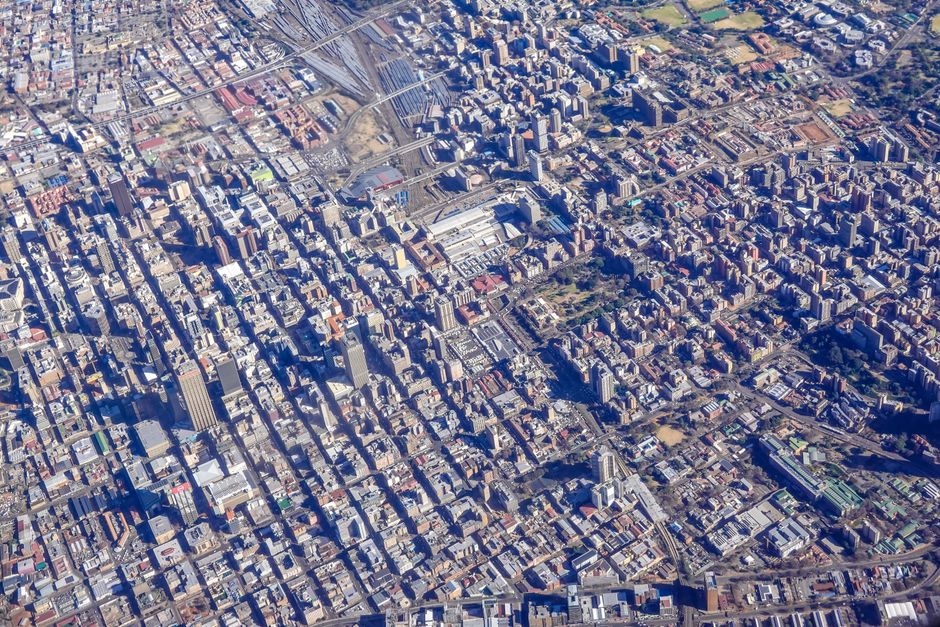
Johannesburg emitted roughly 27.5 million tonnes of CO₂-equivalent in 2025, down from a peak of 33.8 million tonnes recorded in 2019, according to figures released last month by the City of Johannesburg's Environmental Management Department. That 19 percent reduction over six years puts the city on a trajectory that sustainability analysts say is, for the first time, genuinely comparable to the improvement curves logged by London between 2005 and 2012, and Singapore between 2010 and 2018.
The timing matters. Europe is burying its dead from a heatwave that killed more than 2,000 people in France alone during a single peak week, and global pressure on cities to decarbonise is no longer abstract. For Johannesburg, a metropolitan economy responsible for roughly 17 percent of South Africa's total greenhouse gas output, the question is whether recent gains are structural or a statistical blip caused largely by Eskom's rolling blackouts suppressing industrial energy demand.
What the Data Actually Shows
The honest answer is: both. Load-shedding did artificially depress grid consumption between 2022 and 2024, a period when Stage 4 and Stage 6 cuts were routine across Soweto, Sandton and Alexandra alike. But the City's own Green Economy Unit separates out that effect in its modelling, and even on an adjusted basis, the carbon intensity figure — emissions per rand of GDP — fell 18 percent between 2021 and 2025. London's equivalent figure dropped 22 percent over the same four years; Singapore's fell 14 percent. Joburg, in other words, is sandwiched between two of the cities it is measured against.
The drivers are specific. Rooftop solar installations registered with City Power climbed from approximately 8,400 in January 2022 to just over 61,000 by June 2026. The Corridor of Freedom bus rapid transit corridor — running from Thokoza Park station in Soweto through to Rosebank — now carries an estimated 34,000 passengers daily, pulling some of those trips off the N1 and N12 highways. The Joburg Green Building Council recorded 47 newly certified green buildings in the central business district and Sandton precinct during 2025 alone, compared with 11 in 2020.
Where the gap with London and Singapore remains largest is in waste and transport. The Pikitup municipal waste utility sent approximately 1.4 million tonnes of refuse to landfill in 2025; London diverted roughly 53 percent of its municipal waste from landfill the same year, while Singapore hit 55 percent. Joburg's diversion rate sits at 21 percent. On the transport side, Joburg's private car trips still account for an estimated 68 percent of all daily commutes, compared with under 30 percent in Singapore and 36 percent in inner London.
What Closing the Gap Requires
The City's Climate Action Plan, adopted by the ANC-DA coalition council in March 2026, targets a 30 percent reduction in absolute emissions by 2030 from the 2019 baseline. Getting there requires cutting another 4.5 million tonnes over four years — almost exactly the volume that would disappear if Metrorail reform succeeded in shifting one-in-ten current car commuters onto rail. That is a big if. The Joburg Metrorail Modernisation Programme, funded partly through a R2.1 billion national grant announced in the February budget, promises 18 refurbished trainsets on the Central Line by December 2027, but similar promises have missed their dates before.
For residents and businesses, the practical implication is that solar and efficiency investments made now will count. City Power's net-metering tariff, revised in April 2026 to pay R1.18 per kilowatt-hour fed back into the grid, has made the business case for commercial rooftop installations markedly stronger in areas like Rosebank, Bryanston and the Waterfall City precinct. Companies benchmarking against international ESG standards should note that at the current rate of improvement, Joburg's carbon intensity score will cross London's 2020 level sometime around 2029 — three years later than the most optimistic municipal projections, but far sooner than almost anyone was predicting when the decade began.